Introducing the GPUDirect Tape Gateway: RDMA Speed Meets Tape-Scale Capacity
By Meghan McClelland, VP of Product
Versity is introducing a new capability that connects two things not often mentioned in the same sentence: GPUDirect RDMA and tape archives. By supporting S3 over RDMA (Remote Direct Memory Access) through NVIDIA’s cuObject framework, the open source Versity Gateway can now move data directly to and from GPU or host memory at speeds and latencies that traditional network protocols can’t match. Paired with ScoutAM, Versity’s tape archive management platform, that same speed now carries all the way to tape — making Versity the first to bring GPUDirect performance to a tape archive system.
RDMA accelerates data transfer between the archive’s S3 gateway and the S3 client. Behind that fast front door, ScoutAM manages the tape library — writing data to tape and reading it back at scale. The result is a GPUDirect Tape Gateway that pairs full-speed RDMA at the front end with the capacity and durability of tape archive on the back end.
This new capability ships as part of the open source Versity S3 Gateway (versitygw). RDMA and cuObject support, including the GPUDirect Tape Gateway integration with ScoutAM, are not a separate paid tier. The RDMA capability is available to anyone running the open source gateway, enabling access to all of the currently supported backend storage systems.
The Problem With Traditional Storage Networking
Most S3 compatible storage systems move data using TCP/IP, the standard protocol that powers most of the internet. TCP is reliable and well understood, but every time data moves across a TCP connection, the host CPU has to get involved: copying data between memory buffers, managing context switches, and processing network packets in the kernel. NVIDIA, whose GPUDirect Storage (GDS) technology this builds on, frames the problem directly: GDS “enables direct DMA transfers between GPU memory and storage, reducing CPU overhead and helping applications move data with lower latency and higher throughput,” precisely by avoiding that kind of CPU-mediated copying.
As network and accelerator speeds increase, this performance gap widens. Modern GPUs can process data significantly faster than a CPU-bound TCP stack can deliver it, causing expensive compute resources to idle while awaiting data. This bottleneck recurs throughout the data lifecycle, particularly during large dataset recall from mass storage, which traditionally has relied on these same high-overhead network protocols.
What RDMA and cuObject Change
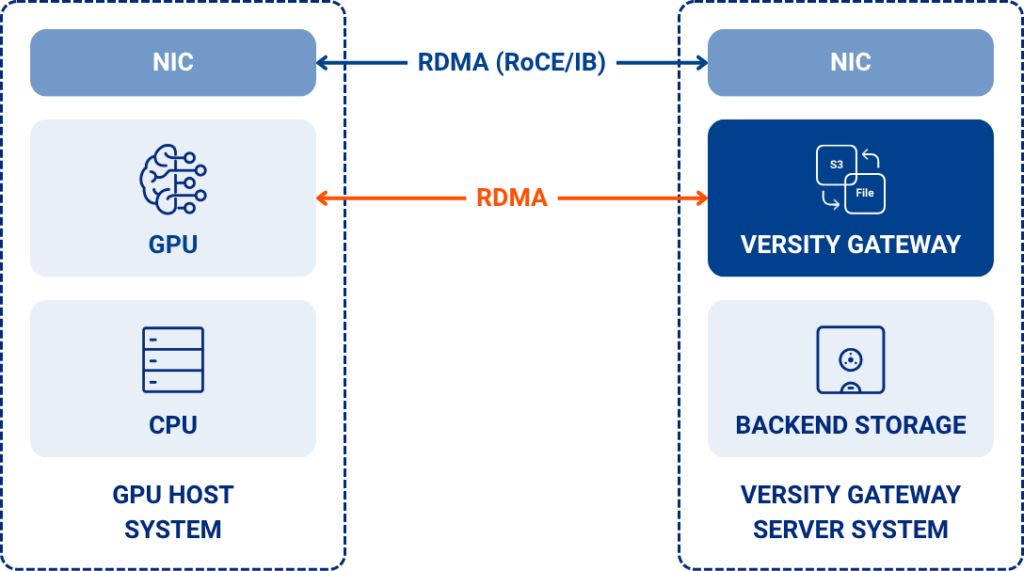
RDMA allows data to move directly between the memory of one system and the memory of another, without routing through the host CPU. NVIDIA’s cuObject framework, part of the GPUDirect Storage ecosystem, applies this to S3 compatible object storage: it gives applications a way to move data directly between GPU or system memory and object storage services using RDMA transports such as InfiniBand or RoCE.
The key design detail is how cuObject splits an S3 request into two separate channels. Session setup, authentication, bucket verification, and object metadata continue to flow in-band, through the standard S3 API, exactly as they would for any other request. The object data itself moves out-of-band, over an RDMA connection that runs alongside the S3 session rather than through it. The cuObjClient manages this data flow on the requesting side and the cuObjServer manages it at scale on the gateway side, but the important distinction isn’t client versus server — it’s that the RDMA data channel never passes through the client’s CPU and never passes through the S3 protocol stack, so it avoids the overhead that protocol would otherwise add to the transfer.
The result is a zero-copy data path: data moves directly between client memory and gateway memory, with no need to stage it through intermediate buffers or temporary files. For workloads that involve GPUs specifically, data can travel directly between the network card and GPU memory, skipping the CPU almost entirely.
(Diagram: a GPU host system — GPU, CPU, NIC — connects over RDMA (RoCE/IB) directly to a VGW server system’s NIC and into VGW memory. Backend storage sits behind the gateway and is reached through the gateway’s normal path, not RDMA. Any number of GPU host clients and any number of VGW server instances can be deployed this way.)
How This Works Inside the Versity Gateway
The Versity Gateway is a stateless, modular, open source S3 gateway that translates standard AWS S3 commands into operations against a range of backend storage systems, including POSIX filesystems, ScoutFS/ScoutAM, and cloud storage. Historically, it has handled data the way most S3 gateways do: receiving HTTP streams over TCP and passing that data to the backend.
The new architecture adds an RDMA-based data path alongside the gateway’s existing control path. This architecture scales by distributing many GPU or host client systems across any number of gateway server instances, each pair establishing its own direct RDMA path between client memory and gateway memory.
In this architecture, the data path is distinct from the control path. For a PUT request, the object is uploaded to the gateway’s memory via RDMA, which the gateway then streams to the backend storage. For a GET request, the data is first staged into the gateway’s memory from the backend storage and then transferred to the client over RDMA. The enables client RDMA access to any of the gateway’s supported backends.
This new capability does not require an overhaul of how S3 requests are authenticated or managed. Authentication, bucket verification, and metadata continue to run through the gateway’s standard control path, independent of the RDMA transfer.
Extending to Tape: The GPUDirect Tape Gateway
That architecture is now available with ScoutAM as the backend, through the integration Versity is calling the GPUDirect Tape Gateway. It addresses a problem that has become more pressing as datasets grow: how to work with enormous volumes of data on cost-effective, durable media without turning storage operations into a drag on GPU-driven pipelines.
Tape has long been the most cost-effective and durable way to store large volumes of data for the long term. It is dense, cost efficient at scale, energy efficient at rest, and well suited to holding data that doesn’t need to be accessed constantly, such as AI training datasets, model checkpoints, simulation results, and compliance archives. As AI and HPC workloads generate ever-larger volumes of data, tape has become an increasingly important part of the storage picture, not despite its differences from flash and disk, but because of them.
Archiving data to tape is likely to remain what it has always been: a steady, ongoing ingest process. Where RDMA changes the equation more meaningfully is on the way back out. AI training pipelines don’t read a dataset once; they reread it, every time a model needs to be retrained or a dataset needs to be reprocessed.
ScoutAM can re-order large data set requests to match the optimal tape offset request locations. ScoutAM can minimize tape mounts, and maximize streaming data performance. Combined with the new capability to utilize RDMA transfer to GPU, recalling massive datasets from tape becomes a feasible approach for model training and other large scale data processing pipelines.
Why This Matters for Customers
This is aimed squarely at the workloads that need it most. Organizations running AI training pipelines, large-scale machine learning jobs, or HPC applications that often find their storage layer, not their compute layer, is the limiting factor. Because the performance gain is most pronounced on the read side, the workloads that benefit most immediately are the ones defined by repeated, large-scale reads: loading and reloading training data into GPU memory, feeding checkpoints back into resumed training runs, and rereading existing datasets for new analysis.
For tape specifically, this changes what’s practical to keep in an active archive rather than treating it as cold storage. Training datasets, checkpoints, and simulation outputs that might previously have felt too slow to recall efficiently can now be pulled back at RDMA speed when it’s time to use them again. Organizations in fields such as genomics, media and entertainment, scientific research, and large-scale AI development, all of which routinely generate data volumes measured in petabytes, get a faster path both to long-term retention and back out again.
Because the gateway remains modular and stateless throughout, customers gain these benefits without changing how they interact with storage day to day. Data still arrives and is retrieved as standard S3 objects; POSIX filesystems and ScoutFS continue to work as they always have, and ScoutAM still manages tape the way it always has. Because the Versity Gateway is open source and includes RDMA support as part of the same project rather than as a separate paid add-on, teams can add this capability to existing S3 workflows without adopting a new proprietary gateway or a new license.
Looking Ahead
This RDMA architecture is a meaningful evolution for the Versity Gateway, extending its role from a flexible protocol translator into a high-performance front end for a range of backends, including tape. It also reflects a broader shift in how organizations can think about tape: not as a slow, disconnected archive tier, but as a high-capacity, low-cost destination that can keep pace with the read-heavy demands of active AI and HPC workflows, provided the recall path is fast enough to make that practical.
That commitment extends to how this ships: RDMA support and the GPUDirect Tape Gateway are open source, included in Versity S3 Gateway rather than gated behind a commercial license. Just as the core gateway made an S3-compatible layer freely available over POSIX, ScoutFS, and cloud storage, Versity is keeping the RDMA path open too, so any team already running Versity S3 Gateway can adopt GPUDirect acceleration directly from the project, without a new procurement conversation standing between them and the performance gain.
That accessibility matters because the scale keeps growing. As AI and HPC workloads push more data through GPU memory, the gateway’s ability to move it at RDMA speed, without sacrificing the compatibility and flexibility Versity Gateway is known for, becomes less of a nice-to-have and more of a baseline requirement. Making that capability open source now means Versity customers do not have to wait to adopt it as their workloads scale.
Frequently Asked Questions
What is the GPUDirect Tape Gateway?
The GPUDirect Tape Gateway is a new capability from Versity that combines GPUDirect RDMA with tape archive storage. It pairs S3 over RDMA support in the Versity S3 Gateway with ScoutAM, Versity’s tape archive management platform, so data can move at RDMA speed between GPU or host memory and a tape-backed archive.
What is GPUDirect RDMA?
GPUDirect RDMA (Remote Direct Memory Access) is a data transfer method that moves data directly between the memory of two systems, such as a GPU and a storage gateway, without routing through the host CPU. This avoids the memory copies, context switches, and packet processing that slow down traditional TCP/IP transfers.
What is NVIDIA cuObject and how does it relate to this?
cuObject is part of NVIDIA’s GPUDirect Storage ecosystem. It gives applications a way to move data directly between GPU or system memory and S3 compatible object storage over RDMA transports like InfiniBand or RoCE. The Versity Gateway uses cuObject to add an RDMA data path alongside its standard S3 control path.
How does data move differently with RDMA compared to standard S3?
With cuObject, an S3 request is split into two channels. Session setup, authentication, bucket verification, and metadata still flow through the standard in-band S3 API. The object data itself moves out-of-band over a direct RDMA connection, so the data path never passes through the client’s CPU or the S3 protocol stack.
Does this require a new or proprietary gateway?
No. RDMA and cuObject support, including the GPUDirect Tape Gateway integration with ScoutAM, are built into the open source Versity S3 Gateway (versitygw). There is no separate paid tier or proprietary gateway required to use them.
Which backend storage systems support RDMA through the Versity Gateway?
The RDMA data path works with any backend the Versity Gateway already supports, including POSIX filesystems, ScoutFS/ScoutAM, and cloud storage. Authentication and metadata handling stay the same across all of them, since RDMA only changes how the data itself moves.
Why does RDMA matter for tape archives specifically?
Tape is dense, durable, and cost efficient at scale, but recall speed has traditionally limited how practical it is for active, repeated use. ScoutAM already optimizes tape recall by reordering requests to match tape offset locations and minimizing tape mounts. Combined with RDMA transfer to GPU memory, this makes recalling large datasets from tape practical for AI training and other large-scale data processing pipelines.
What workloads benefit most from the GPUDirect Tape Gateway?
Workloads defined by large, repeated reads benefit most: AI training pipelines that reload datasets for retraining, checkpoint recovery for resumed training runs, and repeated analysis of existing datasets. Fields that generate petabyte-scale data, such as genomics, media and entertainment, scientific research, and large-scale AI development, are the primary use cases.
Do I need to change how I interact with storage to use this?
No. The Versity Gateway remains stateless and modular. Data still arrives and is retrieved as standard S3 objects, and ScoutFS, POSIX filesystems, and ScoutAM all continue to work as they always have. RDMA adds a faster data path without changing existing S3 workflows.
How do I get started with the GPUDirect Tape Gateway?
Since RDMA and cuObject support are part of the open source Versity S3 Gateway project, any team already running the gateway can adopt GPUDirect acceleration directly, without a new procurement process or license.
The German Climate Computing Center brought its 254 PB climate archive onto Versity ScoutAM with zero data migration, using open-format tape to offload Lustre scratch and keep its costliest HPC storage tier small. What buyers can learn from the deployment.
VersityGW’s POSIX backend maps S3 object keys directly to filesystem paths — no proprietary encoding, no vendor lock-in at the data layer. Learn how administrators use standard POSIX tools alongside the S3 API to manage, back up, and migrate data without gateway dependency.
Forty to sixty petabytes per rack, customer-serviceable, no specialized infrastructure required. Tape is back — but the S3 gateway you choose matters more than the library, and getting it wrong means losing data portability for the entire life of your archive.